Thursday, March 3, 2022

The View from BELL ROCK – Inflation Remains a Key Question, Jobs Take Center Stage

Quarterly corporate earnings are poised to come in strong, resulting from increased share buybacks and a rise in M&A activity throughout the last year.  The recent positive stress test results in the banking sector supported several immediate dividend boosts and share repurchase plans from large banks (such as JPMCiti, etc.).  On the fiscal agenda, the $1T scaled back infrastructure proposal may have enough support to move forward.  Meanwhile, inflationary concerns remain on our radar, as do the potential ramifications on the economy as they continue to resume to normalcy with questions on recent Covid-19 variants. 

Monetary Policy – The Fed Holds Firm

The recent Federal Reserve meeting in June was surrounded with so much fanfare that it was almost deafening. Sure, it was an important meeting, but we have had many important meetings over the last fifteen years. The June meeting felt over-hyped in terms of importance to our team.  Did the markets really expect a “tell” from this meeting?

Chairman Powell remains committed to easy monetary policy and he is confident that inflation remains temporary, influenced by the pandemic and should normalize as the economy continues to re-open throughout the country.   It is our view, the Federal Reserve remains data dependent and it would move sooner to raise rates than year-end 2023, should strong economic conditions persist.  Jobs data seems to be the driver.  The U.S. remains 7.13 million jobs below pre-Covid levels. But the inflationary tug-of-war is creating volatility along the yield curve. The Fed continues to have a critical role during the pandemic, and it will for the next 12-24 months. A healthy and growing economy could have a Fed funds rate back near 2% by year-end 2023 and that is an appropriate level that could accompany healthy GDP growth and inflation levels. Inflation at 5% is running above the Fed’s noted 2% comfort level.  The FOMC’s view continues to be this inflation rate only because of the comparison to the negative rate running this time last year.  Whether they are right remains to be seen.  We believe the economic statistics, going into the Fall 2021, will likely present a more accurate view of jobs.  Of course, if the Fed has played this incorrectly, we can expect very volatile markets.

Fiscal Policy – Yes, there is more, but how much?

The America Rescue Plan Act of 2021 was valued at $1.9T, bringing the total Covid stimuli to nearly $5T.  The proposed US infrastructure plans have been near $3T.  Although, the most recent scaled version is approximately $1T. Because of the composition of the Senate, it seems that anything over $1 trillion, fortunately, will not pass.  We are concerned about rampant spending until the proof of what amount of the $5 trillion is ingested.  We note, the IMF just increased its projection for U.S. GDP growth to 7% which includes more than the scaled down version of the infrastructure plan.  We would expect the IMF’s global growth forecast to adjust to 6% for 2021 and 4.4% in 2022, based upon the vaccine rollout across the world. Therefore, renewed economic growth to be revised upward as well.  

Capital Management Strategies are Restarting. 

Last year, many companies cut their dividends and suspended share buybacks to fortify their balance sheets and preserve capital.  Over the last few weeks, financial services companies have announced share buybacks. After Covid forced belt tightening on typical capital management techniques, buybacks and dividends, both are poised for a comeback.  In fact, companies in the S&P 500 Index are positioned to pay more than $530B in dividends in 2021. Up from approximately $500b in 2020.  

We regularly post market commentary, and it is important to remember that these are short-term views. We adjust respective asset allocations to the individual’s time horizon and risk characteristics.  We thank you for your continued faith and trust in us. Stay safe. Stay healthy. Stay happy.

Read more on Bell Rock Capital.

<link rel="canonical" href="https://bellrockcapital.com/the-view-from-bell-rock-inflation-remains-a-key-question-jobs-take-center-stage/" />


from WordPress https://ift.tt/jHu5UA1
via IFTTT

Wednesday, March 2, 2022

February 24, 2022

We have been watching the details in the Ukraine unfold, just as you have.  We are not political theorists or commentators, so we are not going to try to give our readers a synopsis on why the developments between Russia and the Ukraine are happening.  All we care about, as professionals, is solely to focus on our client’s best interest.

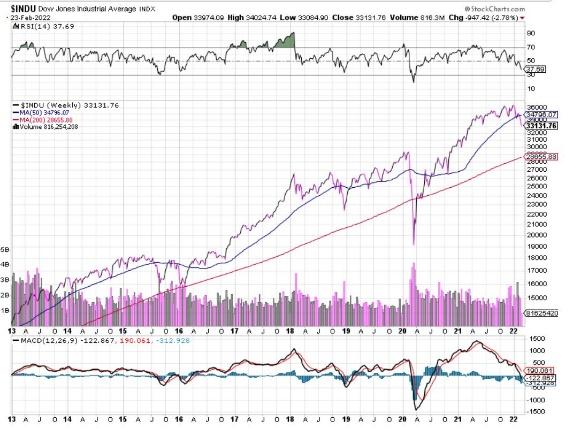
Since the beginning of 2022, the markets have been dismal. The push-pull between inflation and waiting for the Fed to address that with raising interest rates has weighed on the markets, as have the continued supply-chain issues. There has been a clear unfavorable attitude towards growth stocks (ie technology) and we’ve seen bond prices retreat a bit in anticipation of higher interest rates. But with the events of the last 24 hours, we believe the impact will affect all of the above, and perhaps give reason for the Fed and investors to quickly re-consider the above set in stone course we were expecting.  What does that mean? One could argue that what has happened in the price of gas prices and oil prices was avoidable, but for twelve months ago the US energy independence was stripped away with the stroke of a pen, unfortunately. But it is what it is. That means the price of oil is now quoted at over $105 a barrel, and gas prices at the pump will rise. This by default means a slowdown in the US consumer spending because this is a large tax on US consumers who now must spend significantly more for gas than a month ago, and grossly more than 12 months ago. This is a natural slowdown that may force the hand of the Fed to leave rates alone and let the tectonic forces of the economy shift around on their own.

Chart, histogram Description automatically generated
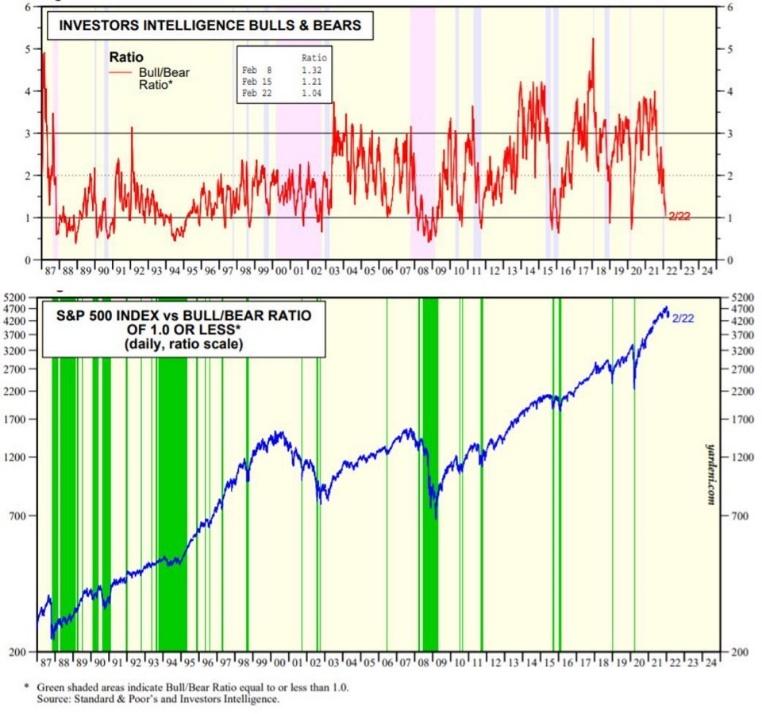
Chart, line chart Description automatically generated

We base our assumptions on modern history of Russian activity, namely the annex of Crimea which was a couple of difficult days for the world, and the markets, but then over, and a strong upward reversal. 

We’ve watched this market correction over the last several weeks, and yes, we still believe this is a correction and not the sign of some major catastrophic course.  Normal, natural, and long overdue, which is why we have tried to stockpile cash and wait for buying opportunities for those who are patient. In fact, we’ve borrowed a chart from respected economist Ed Yardeni, who yesterday us that one of the best contrarian indicators is when the bears are running on the street.  The bull-bear ratio indicator is now almost at 1.  That means equal numbers of investors who are in the bull and bear camp. This ratio will fall below 1 today or tomorrow, and this is an extraordinarily strong indicator for an upward reversal, and historically a strong buy signal that must be grabbed by those who have been waiting for real position entry points.

These are never easy times, they are stomach churning at times, but to be honest, after all these years we have seen much worse. And yes, some will say, “this time is different,” but sadly, we are too jaded now to think this way. We have seen enough “different” to know in fact, all these downturns are the same. Just look at the charts. Those who buy when the streets are flowing with the carnage of the fearful, will smile six months are a year from now.

If you have any questions, or concerns, please do not hesitate to call your advisor. We are, as always, grateful for your trust and faith in us.

<link rel="canonical" href="https://bellrockcapital.com/february-24-2022/" />


from WordPress https://ift.tt/7g2XnQt
via IFTTT

Retire with Peace of Mind

Thinking About Retirement?

Whether you’re getting ready to retire, or you’re just getting ahead, here’s what you need to know.
As you look ahead to retirement, the idea of no longer working and earning income may have you asking a lot of questions about how to prepare for such an important change. But with the right amount of planning, life after work can be the life you’ve always wanted.

By making a plan now for what you want to accomplish after you retire, you can make the most of your retirement.

In fact, there are three basic steps that everyone can follow, regardless of their
income or wealth, to simplify the transition to retirement.

  • Identify how much income you need each month to live similar to current lifestyle
  • Determine your income sources (such as Social Security or pensions) and consider if it best to defer Social Security benefits, or in what order income sources should be used
  • Plan for risks that may alter plan, or encouragement about attaining dream goals

Saving enough money to accommodate the lifestyle you desire, and the experiences you want to have is the chief concern of many people as they consider retirement. Most people feel confident they can retire comfortably…but they also haven’t done the calculations to know for sure.


Retiring Well: Important Spending and Saving Considerations


If you want to be confident you’ll have the means necessary to enjoy the experiences you’ve been planning after you stop working, you need to set and stick to a budget.

That’s right—after you are no longer earning income through work, your budget will become even more important. As long as you follow the three steps we identified to make your transition to retirement easy, this shouldn’t be a concern. However, all plans need to leave room for the unknown. What if you experience high healthcare costs, or live a longer life than anticipated? Budgeting is key, so be sure you have not only a budget plan to follow, but also the tools to track and monitor your progress.

Another important consideration is retirement age. As long as you enjoy your work and are physically able to continue working, it may be worth delaying retirement for a year or two to ensure you have the cash flow necessary to accommodate the unknown parts of your future. A failure to plan for longevity may increase doubt and anxiety about your financial security.

Retire with Peace of Mind

Your future financial security starts with a plan.

As the old proverb says, “The best time to plant a tree was twenty years ago. The second best time is now.” By educating yourself about your retirement cash flow now, you can set yourself up for success simply by
adjusting your expectations to match.

One of the best ways to ensure your financial goals are on track is to document them as part of a financial plan. With the right resources and expertise, the planning process can be simple. And technology available today can even enable you to monitor spending, track progress toward your goals, and evaluate your plan from the palm of your hand.

<link rel="canonical" href="https://bellrockcapital.com/retire-with-peace-of-mind/" />


from WordPress https://ift.tt/t6Qqx5L
via IFTTT

5 Life Changes to Tell Your Advisor About

The meticulous financial plan your advisor drew up is not Gibraltar, forever solid and unchanging. Altered circumstances require your plan to change, too. 

Here are the five life changes you should tell your advisor about: 

Marital Status. 

The way of the world: People get married, and some get divorced. Either way, joint assets are an issue. Your advisor can walk you through what you need to know and what to plan for. 

When you get married, there are a host of questions. Is it a two-paycheck marriage? You need to look at whether you will combine bank accounts, who will pay for what, will you invest separately or together, how will you handle debt, what are your insurance needs? If you both own a house, what do you want to do with your property, and what are the tax consequences of selling one of the dwellings? 

As you start your marriage, planning for its possible end seems like walking under a ladder. Most divorce proceedings split assets 50-50. A prenuptial agreement, while it seems to blight a romance, is good for special circumstances – say one spouse has children from a previous marriage who need to be looked after, and the other partner is childless. 

Whatever you decide, dividing assets is best done between the divorcing spouses, before lawyers get involved. “If you are on speaking terms, this makes the most sense,” says Craig Poeppelman, a financial advisor with Harper Associates in Upper Arlington, Ohio. “The attorneys have no incentive to settle things. They are on the clock.”

Becoming a Parent. 

As the saying goes, you not only add a child. You also add a future financial commitment to medical care, summer camps, new and ever-larger clothing, braces and college. Kids are expensive. 

Your advisor should provide a checklist of what you need to consider – and how you can afford it. Checking what your health plan covers for pregnancy is the first step. Day care, if both spouses will continue to work, is a pricey proposition, eating up as much as a fifth of a couple’s income. 

College expenses are enormous, so getting ready early is wise. The average cost for tuition and fees at a private four-year college is $25,000, and at public institutions for in-state residents, $6,500.  The most expensive top $35,000. A welter of loan and grant programs exist that an advisor can navigate for you. You need to figure out what part of college costs you, the parent, will pay. “Is it 75%, or 100%?” says Jeffrey Baumert, a partner at Advisor Financial Services in Woodstock, Ga. Very few kids get a free ride from scholarships and grants. 

The best means of getting ready is a 529 savings plan, named after the tax code section creating it. You sock away money now for tomorrow’s college bills. The beauty of this: Every dime your invested money earns in capital gains, dividends or interest is tax-free if used to pay for higher education. Should you invest in the plan your state sponsors, your investments may be deductible on state tax returns. You aren’t locked into your state’s plan, and can adopt another state’s. 

Health Problems.

These could mean higher spending from your own pocket. Your financial plan may need to be readjusted to reflect how much cash you must pull from investments. “The question is how much higher the distribution amount to you will be,” Gartner says. An advisor can help you decipher what your medical plan covers and what it doesn’t. Some have no lifetime maximums, good news if you have a serious illness. Others won’t pay bills over $500,000. 

An advisor should tell you beforehand what coverage you need, should you lack it. An illness or injury may strike at any time without warning. For someone without adequate coverage, says John Orlando, the chief investment officer at Financial Security Advisory, in Virginia Beach, Va., the expense “can destroy your life.” 

Inheriting Assets.

Gaining a sudden lump sum, the temptation is to spend the windfall right away. An advisor can steer you away from that and show you how to invest it so it bolsters your finances. The best plan is to shove the money into a well-diversified group of mutual funds. 

Tax planning is vital. If the money comes from the individual retirement account of your spouse, who just died, the IRA should be retitled in your name. Withdrawing some of the money for your personal use, before age 59 ½, can make all of it taxable. If you inherit an IRA from someone other than your spouse, an advisor can show you that the best course is to open a new IRA in your name and transfer the proceeds directly to it. That way, the money doesn’t run through your bank account, thus making it subject to taxation. 

The best way to regard inherited money, before you’ve received it, is not to count on it, Gartner says. “Your father dies and you believe you will receive his money, but then your mom re-marries” and may alter the will, he says. 

Buying Real Estate.

For many, purchasing a home is the biggest single outlay they will make in their lives. A home also is the largest asset for most, even after the housing bust that started in 2006. Yes, home appreciation won’t skyrocket any longer, as it used to. Prices are still falling in some parts of the nation. Once the housing market stabilizes, you likely can expect home appreciation to revert to its normal rate, which tracks inflation. 

Still, the classic benefits of homeownership remain. You can deduct mortgage interest and local property taxes on your federal tax returns. Your capital gains, up to around $500,000, are tax-free should you sell. Typically, house payments are less than rent. And you do build equity, albeit at a slower pace nowadays. 

Buying a second home has traps. If you rent it to tenants, you can treat it like a first home for tax purposes – but only by living in it at least 14 days a year. 

Buying undeveloped land is even tougher. Unless you can rent it out for farming or hunting, it generates no income and plenty of property taxes. You have to hope that you can develop it lucratively, or sell it to a builder. 

An advisor can show you how to work through these complexities. One of Gartner’s clients reported that he had just paid a large sum for several acres of raw land. Gartner thought it was a raw deal. “Fortunately, he had seven days to back out of the deal,” Gartner says. It pays to have someone like Gartner looking over your shoulder.


from WordPress https://ift.tt/wKS54uP
via IFTTT

The View from BELL ROCK – Inflation Remains a Key Question, Jobs Take Center Stage

Quarterly corporate earnings are poised to come in strong, resulting from increased share buybacks and a rise in M&A activity throughout...